ERD
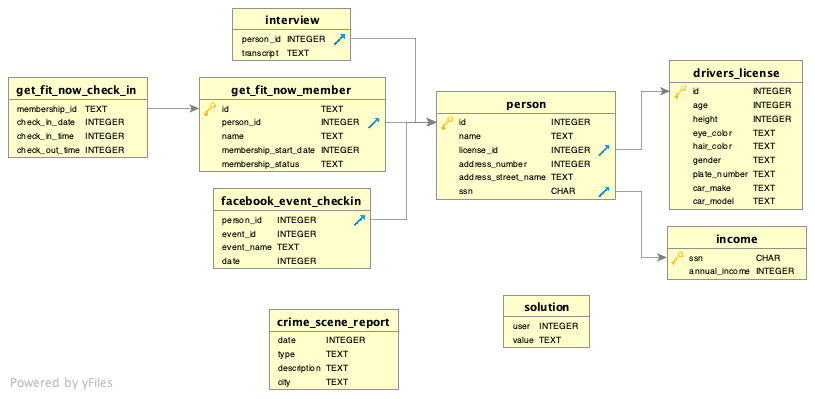
An entity-relationship diagram describes the tables in a database and the relationships between them
![]()
ERD
- Primary key: a unique identifier for rows of a table
- A primary key can be built from one column or from multiple columns
- Every row must have a value for the primary key
- No two rows can have the same value for the primary key
- Each table can have at most one primary key
- Example:
id in the person table, id in the drivers_license table
ERD
- Foreign key: references a primary key in another table
- Foreign keys describe relationships between tables
- Values of a foreign key can be repeated in the table
- Example:
person_id in facebook_event_checkin table references id in person table
Maintaining referential integrity
- A foreign key cannot have values which do not appear in the primary key for the referenced table
- Example: the
person_id column in the facebook_event_checkin table cannot take values which do not appear in the id column of the person table
- Deleting a row from a table with a primary key is not permitted if that value appears in a referenced foreign key
Class activity
Work on the class activity (handout).
Class activity
What columns could be primary keys in the nycflights13 tables?
Class activity
What columns could be foreign keys in the nycflights13 tables? What primary keys do they reference in other tables?
Class activity
ERD sketch for the nycflights13 datasets:
Class activity, Part II
Now work on the second class activity (on course website). Render your work as an HTML and submit on Canvas when finished.